January 10, 2023

Wheat Yield and Protein Estimation with Handheld and Unmanned Aerial Vehicle-Mounted Sensors.

Wheat Yield and Protein Estimation with Handheld and Unmanned Aerial Vehicle-Mounted Sensors

1
Parma R&E Center, University of Idaho, Parma, ID 83660, USA
2
Idaho Falls R&E Center, University of Idaho, Idaho Falls, ID 83402, USA
3
Aberdeen R&E Center, University of Idaho, Aberdeen, ID 83210, USA
4
AG Idaho Consulting LLC, Wilder, ID 83676, USA
*
Author to whom correspondence should be addressed.
Agronomy 202313(1), 207; https://doi.org/10.3390/agronomy13010207 (registering DOI)
Received: 11 November 2022 / Revised: 29 December 2022 / Accepted: 2 January 2023 / Published: 10 January 2023
Abstract
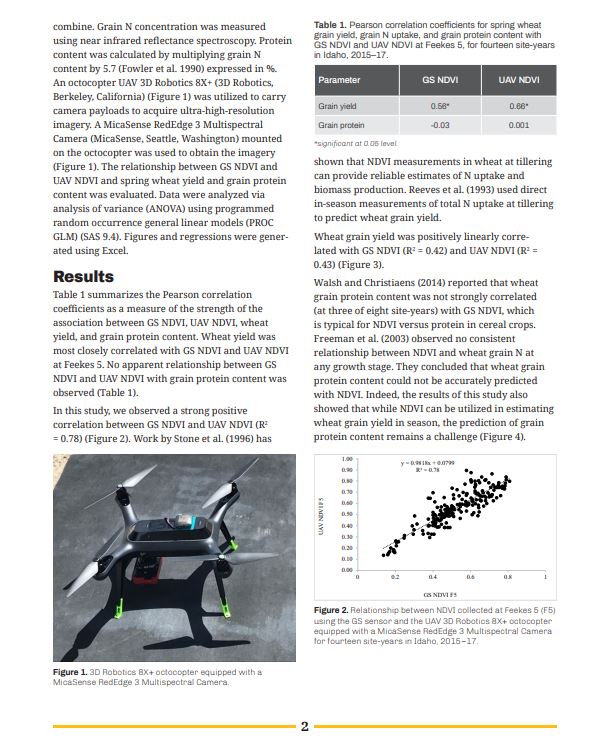
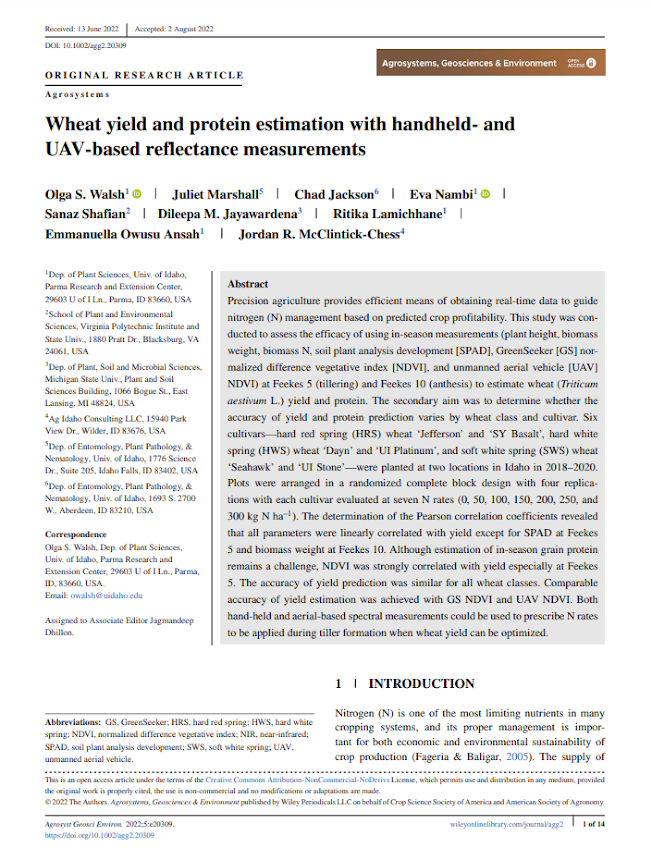
Accurate sensor-based prediction of crop yield and grain quality in-season would enable growers to adjust nitrogen (N) fertilizer management for optimized production. This study assessed the feasibility (and compared the accuracy) of wheat (Triticum aestivum L.) yield, grain N uptake, and protein content prediction with in-season crop spectral reflectance measurements (Normalized Difference Vegetative Index, NDVI) obtained with a handheld GreenSeeker (GS) sensor and an Unmanned Aerial Vehicle (UAV)-mounted sensor. A strong positive correlation was observed between GS NDVI and UAV NDVI at Feekes 5 (R2 = 0.78) and Feekes 10 (R2 = 0.70). At Feekes 5, GS NDVI and UAV NDVI explained 42% and 43% of wheat yield, respectively. The correlation was weaker at Feekes 10 (R2 of 0.34 and 0.25 for GS NDVI and UAV NDVI, respectively). The accuracy of wheat grain N uptake prediction was comparable to that of yield: the R2 values for GS NDVI and UAV NDVI were 0.53 and 0.37 at Feekes 5 and 0.13 and 0.20 at Feekes 10. We found that neither GS NDVI nor UAV NDVI in-season data were useful in prediction of wheat grain protein content. In conclusion, wheat yield and grain N uptake can be estimated at Feekes 5 using either handheld or aerial based NDVI with comparable accuracy.
We hypothesized that the in-season NDVI from handheld (GS) and aerial (UAV) sensors can be used to accurately estimate wheat yield, grain N uptake, and protein content. Our results have confirmed that wheat yield and grain N uptake can be estimated with GS NDVI and UAV NDVI. We observed a strong linear relationship between GS NDVI and UAV NDVI (0.78), especially at tillering. The GS NDVI and UAV NDVI relationship with wheat yield and N uptake was stronger at tillering compared to flowering. This makes sense because at tillering the plant vigor is high and most of N uptake is channeled towards biomass production. In contrast, at the flowering stage, the N uptake direction is shifted towards grain production. The GS NDVI and UAV NDVI correlation with wheat yield and grain N uptake were comparable. We found that neither GS NDVI nor UAV NDVI in-season data were particularly useful in the prediction of wheat grain protein content.
Author Contributions: Conceptualization, O.S.W. and J.M.M.; Methodology, O.S.W. and J.M.-C.; Investigation, J.M.-C. and C.A.J.; Data curation, O.S.W., E.N., R.L., E.O.A. and F.B.; Writing—original draft, E.N.; Writing—review and editing, O.S.W. and E.N.; Visualization, O.S.W.; Supervision, O.S.W. and J.M.-C.; Project administration, O.S.W. and J.M.M.; Funding acquisition, O.S.W. and J.M.M. All authors have read and agreed to the published version of the manuscript.
Funding: This work was funded in part by the Idaho Wheat Commission and the Idaho wheat producers.


September 27, 2022

Wheat yield and protein estimation with handheld- and UAV-based reflectance measurements

 Core Ideas

∙ GreenSeeker (GS) and UAV NDVI at Feekes 5 shows the most potential for in-season wheat yield estimation.
∙ Comparable accuracy of yield estimation was achieved with GS NDVI and UAV NDVI.
∙ The accuracy of yield estimation was comparable for all wheat classes and cultivars.
∙ Estimation of in-season wheat protein content remains a challenge.


September 23, 2022

UI Parma MS student to serve on national Graduate Student Committee


Our MS student, Emmanuella Owusu Ansah, a graduate research assistant in the Cropping Systems Agronomy program at UI Parma, has been selected to serve on this committee, and she will also be participating in the Graduate Student Leadership Conference at the tri-societies' annual meeting in Baltimore, MD in November. 


July 11, 2022

Spring wheat yield and grain quality response to nitrogen rate


 Core Ideas

  • Application of all N fertilizer at planting is not efficient for wheat.
  • Nitrogen fertilizer rates for wheat should account for site- and year-specific conditions.
  • When prescribing N rates to wheat, yield potential and responsiveness to N should be considered.
  • Higher N rates resulted in enhanced grain protein content, but low N use efficiency.

Mott Award Honors Top Graduate Students

Congratulations to the students who are recipients of this year’s Gerald O. Mott Meritorious Graduate Student Award in Crop Science. This annual award recognizes top-notch graduate students pursuing advanced degrees in crop science disciplines. Departments select students based on academic achievements, research and teaching contributions, leadership accomplishments, service activities, and personal qualifications. Multiple students from one school may be recognized as these students represent their departments.

The award is named for the first CSSA President, Gerald O. Mott, who trained 75 graduate students during his 45-year career at Purdue University and the University of Florida. Many of his students have become eminent forage scientists in the United States and Latin America. The award is offered by CSSA.

Congratulations to Ms. Ritika Lamichhane, MS student, Graduate Research Assistant, Cropping Systems Agronomy program, University of Idaho, Parma R&E Center for receiving this prestigious award!


June 22, 2022

Top Downloaded Manuscript: Seeding rate and nitrogen fertilizer rate effect on dryland no-till hard red spring wheat yield and quality


 Core Ideas
  • Nitrogen rate significantly affected wheat grain yield, protein content, protein yield, and N uptake at both locations, and N use efficiency at one of two locations.
  • The 135 and 67 kg ha−1 pure live seed seeding rates resulted in comparable grain yield, test weight, grain protein, protein yield, and N uptake.
  • Wheat protein yield was highest at 140 kg N ha−1; higher N rate (especially split-applied) may have improved wheat production further.
No inverse yield–protein relationship was observed at any of two locations.