Core Ideas
Pages
- HOME
- ABOUT
- SCHOLARLY PUBLICATIONS
- RESEARCH
- TEACHING & MENTORING
- EXTENSION & OUTREACH
- SERVICE
- UI Parma Agronomy Program
- Idaho Crops & Soils Newsletter
- Southwest Idaho Cereals Program
- Nutrient 4Rs
- Soil Health
- University of Idaho AgTalk Tuesdays
- Western Ag Variety Explorer - WAVE
- UAV for Fruit Tree Monitoring
- Micronutrients for Wheat
- Precision Irrigation for Hops
- Water and Soil Management for Beans
- Nitrogen and Water Management for Sugar Beets
- Water and Nutrient Footprint of Pulse Crops
- PLSC 500 - Master's Research & Thesis
September 27, 2022
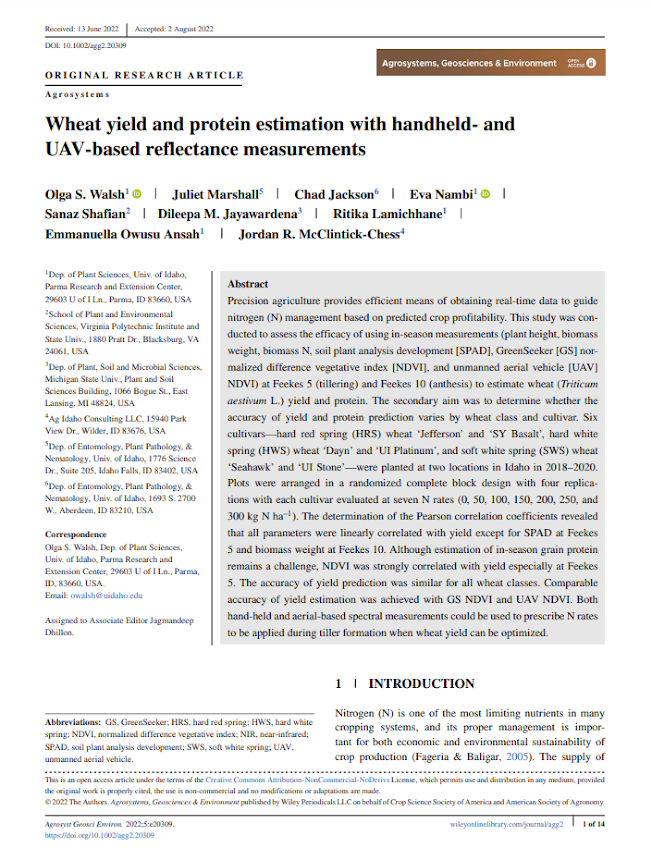
Wheat yield and protein estimation with handheld- and UAV-based reflectance measurements
September 23, 2022
UI Parma MS student to serve on national Graduate Student Committee
Our MS student, Emmanuella Owusu Ansah, a graduate research assistant in the Cropping Systems Agronomy program at UI Parma, has been selected to serve on this committee, and she will also be participating in the Graduate Student Leadership Conference at the tri-societies' annual meeting in Baltimore, MD in November.
July 25, 2022
July 11, 2022
Spring wheat yield and grain quality response to nitrogen rate
Core Ideas
- Application of all N fertilizer at planting is not efficient for wheat.
- Nitrogen fertilizer rates for wheat should account for site- and year-specific conditions.
- When prescribing N rates to wheat, yield potential and responsiveness to N should be considered.
- Higher N rates resulted in enhanced grain protein content, but low N use efficiency.
Mott Award Honors Top Graduate Students
Congratulations to the students who are recipients of this year’s Gerald O. Mott Meritorious Graduate Student Award in Crop Science. This annual award recognizes top-notch graduate students pursuing advanced degrees in crop science disciplines. Departments select students based on academic achievements, research and teaching contributions, leadership accomplishments, service activities, and personal qualifications. Multiple students from one school may be recognized as these students represent their departments.
The award is named for the first CSSA President, Gerald O. Mott, who trained 75 graduate students during his 45-year career at Purdue University and the University of Florida. Many of his students have become eminent forage scientists in the United States and Latin America. The award is offered by CSSA.
Congratulations to Ms. Ritika Lamichhane, MS student, Graduate Research Assistant, Cropping Systems Agronomy program, University of Idaho, Parma R&E Center for receiving this prestigious award!
June 22, 2022
Top Downloaded Manuscript: Seeding rate and nitrogen fertilizer rate effect on dryland no-till hard red spring wheat yield and quality
Core Ideas
- Nitrogen rate significantly affected wheat grain yield, protein content, protein yield, and N uptake at both locations, and N use efficiency at one of two locations.
- The 135 and 67 kg ha−1 pure live seed seeding rates resulted in comparable grain yield, test weight, grain protein, protein yield, and N uptake.
- Wheat protein yield was highest at 140 kg N ha−1; higher N rate (especially split-applied) may have improved wheat production further.
June 13, 2022
April 27, 2022
2022 Southern Idaho Cropping School (Virtual)
Thanks to Marketing & Comm. Manager, Ms. Amy Calabretta, University of Idaho Communications and Marketing
April 21, 2022
University of Idaho Extension: Ag Talk Tuesdays
Brought to you by University of Idaho Extension:
We are excited to announce Ag Talk Tuesday sessions resume May 3 for the 2022 season.
Each session starts at 11:00 AM (MDT) on the first and third Tuesdays, May through August.
These live events begin with crop updates where all participants are invited to contribute, followed by a featured presentation. You can find a schedule of featured topics and speakers (subject to change) and more information on our website:
Registration is required to attend. You only need to register once to attend all sessions. Once you register, information on how to attend via Zoom or by calling in by phone will be sent to you in a separate email.
To register, click this link (or copy and paste the following into your web browser):
https://uidaho.zoom.us/meeting/register/tZElce6uqTwpH9CuQSsCTa_7B01HC8gfuGXn
Please join us starting May 3 at 11:00 AM (MDT) for these live, online sessions that focus on agriculture - current season issues related to pests, diseases, weeds, diagnostics, soil health, irrigation/water, agronomy & more along with featured topics and guest speakers.
For questions, please contact one of the organizers:
Kasia Duellman (kduellman@uidaho.edu)
Doug Finkelnburg (dougf@uidaho.edu)
Pam Hutchinson (phutch@uidaho.edu)
Juliet Marshall (jmarshall@uidaho.edu)
Olga Walsh (owalsh@uidaho.edu)
January 27, 2022
Research Aide, Cropping Systems Agronomy - available at University of Idaho, Parma R&E Center
The Research Aide will provide assistance to the PI, Dr. Olga Walsh, as part of the Cropping Systems Agronomy research and extension program, and will conduct field, greenhouse, and laboratory experiments focused on plant nutrition, fertilizer, and water use efficiency. Location: University of Idaho, Parma R&E Center, Parma, Idaho.
First consideration date for receipt of applications is February 10, 2022.
Required Documents:
- Resume/CV
- Letter of Qualification
IMPORTANT: To be considered, your “Letter of Qualification” must address EACH of the required qualifications, including pertinent education and/or experience. In addition, to improve your ranking during the evaluation process, address as many of the Preferred Qualifications as possible. Information on a resume WILL NOT be accepted as a substitute for submitting a Letter of Qualification.
Posting Number: SP003222P
Location: Parma, Idaho
Division/College: Col of Agricultural & Life Sciences
Department: Plant Sciences
FLSA Status: Overtime Eligible
Employee Category: Classified
Pay Range: $15.46 per hour or higher depending on experience
Type of Appointment: Fiscal Year
Full Time/Part Time: Full Time
JOB DUTIES:
Conduct field/greenhouse/laboratory research and perform extension/outreach activities:
- Assisting in the implementation of experiments in the field, greenhouse and laboratory. Preparing and implementing field plot plans and assisting with care of field experiments according to treatment structure.
- Driving to various field sites.
- Assisting with seed preparation, planting, plot maintenance, harvest, and grain processing.
- Coordinating field trial work with supervisor and farm manager in terms of irrigation, fertilization, and weed and pest management.
- Collecting soil, plant, water, and gas samples and preparing them for analysis and utilizing laboratory instrumentation to measure samples.
- Keeping organized and up-to-date record of all work activities related to experiments.
- Assisting with proofing documents and reports.
- Assisting in organizing field days, workshops and seminars and other educational extension/outreach events.
- Working on a team that includes growers and agricultural clients.
- Supervising and training temporary employees. Assigning tasks during their work hours. Training them in the use of basic equipment used for agricultural research and how to work safety.
- Maintaining organized work area, ordering supplies and keeping equipment in working order.
- Must have a valid driver’s license and be able to successfully pass a driver’s record check.
- Idaho Limited Pesticide Applicator’s License or be able to obtain one within six months of hire.
- Bachelor’s degree in Agronomy, Plant Science, Soil Science or similar area.
- Hands-on research experience through coursework, employment, internships, fellowships or similar educational opportunity.
- At least five years’ experience in managing field crops.
- Experience in operating farm equipment and knowledge of basic crop production practices.
- Experience with conducting field studies in fertilizer and water use for improved crop yield and quality.
- Ability to give full attention to tasks at hand.
- Demonstrated ability to work independently and in a group.
- Experience with agricultural research methods and techniques.
- Experience at a University research & extension center.
- Experience with and understanding of Idaho and Northwest US cropping systems.
- Experience with soil-plant-water-gas sampling, preparation, and analytical analyses using various instrumentation.
- Experience with precision agriculture tools such as sensor-based technologies, crop sensors, irrigated crop production systems is highly preferred.
- Ability to lift, carry, and/or otherwise move up to 50 pounds.
- Ability to work outside for long periods of time under inclement weather conditions.
January 04, 2022
Economic Impacts of Climate Change on Agriculture in Idaho
Hatzenbuehler, P., Wardropper, C., Adjesiwor, A., Ansah, E. O., Burnham, M., de Haro-Martí, Dentzman, K., Findlay, J. R., Glaze Jr., J. B., Hinds, J., Jansen, V., Karl, J., Lamichhane, R., Lew, R., Olsen, N., Powell, M., Running, K., Sagers, J., Schott, L., Walsh, O., and Wilson, B. 2021. Economic Impacts of Climate Change on Agriculture in Idaho. Idaho Climate-Economy Impacts Assessment. James A. & Louise McClure Center for Public Policy Research, University of Idaho. Boise, ID. pp 46
ICEIA main website: https://www.uidaho.edu/president/direct-reports/mcclure-center/iceia
ICEIA Agriculture website: https://www.uidaho.edu/president/direct-reports/mcclure-center/iceia/agriculture
food and beverage processing accounting for over 18% of total business sales (Idaho State
Department of Agriculture (ISDA), 2020). Conditions in the sector influence the lives of all
Idahoans to at least some degree through provision of food that fuels daily activities. The goal of this report is to describe the economic risks and opportunities for the Idaho agricultural sector in the context of climate change. The report describes current conditions in the Idaho agricultural sector, observed changes in Idaho’s climate and trends in agricultural productivity over the past several decades, projected changes in Idaho’s climate and agricultural productivity for key subsectors, specific effects of the changing climate on key agricultural subsectors as identified in the peer-reviewed research literature, the important linkages between water availability and agricultural sector performance, and existing evidence of adaptation strategy adoption by Idaho farmers.
Given the uncertainty regarding future conditions for the climate, environmental resource policy, agricultural markets, demographics, and general macroeconomic conditions, a numerical estimation of economy-wide variables was not calculated. However, the report provides stakeholders essential information that characterizes the linkages between climate and agricultural production and the risks and opportunities based on their location, current climate conditions, and projections for future climate and water availability. Additionally, many
plausible adaptation strategies that Idaho farmers and ranchers may adopt in response to future changes in climate are provided. Such insights can be used by policymakers and stakeholders to consider potential impacts on their own institutions and businesses and plan appropriate responses. The interactions between adjustments in grower practices in the context of climate change, and especially the effects of such shifts on water availability, will be key to explaining the performance of the Idaho agricultural sector in the decades ahead.
Wheat Characteristics under Varied Irrigation and Nitrogen
- A strong positive correlation was observed between grain yield and irrigation but not with the N rate. The results suggest that irrigation can be reduced by 25% (medium irrigation) while crops maintain optimal grain yield and grain protein content. This recommendation will help to reduce water usage by 25% during wheat production in semiarid cropping systems.
- Application of 150 kg N ha-1 (soil residual N plus added fertilizer) is sufficient to optimize the grain yield and protein content of irrigated spring wheat grown in Idaho and Montana. This rate is lower than the currently recommended N rate in each state. Therefore, this recommendation will minimize input costs during wheat production, environmental impacts, and human health concerns.
- Strong positive correlations of SPAD or NDVI with grain yield suggest the feasibility of using these crop sensors for in-season wheat yield assessment, especially in irrigated cropping systems.
November 12, 2021
Your Grower Dollars at Work: University of Idaho Preliminary Yield Results for Spring Wheat in Parma
Both Hard Red Spring and Hard White Spring were trialed under irrigation. In a tough production year, the Hard Red trial averaged 54 bu/ac. with a mean test weight of 61.1 lbs. SY Gunsight, WA 8356, and AP Renegade were the top yielders. The Hard White trial yield was similar with a mean of 55 bu/ac. and an average test weight of 60.6 lbs. IDO2002S, SY Teton, and Dayn topped the entry list.
In the Soft White Spring trial, low yields pulled the mean trial yield to 47 bu/ac. while test weights held at an average of 60. IDO1902S, IDO1404S, and UI Stone produced the best in the challenging conditions. Preliminary results for irrigated club wheat, feed, and malt barley can be found at the same link. Further information about Dr. Walsh and her work can be found here.
By: Dr. Garrett R. Dudley, Research Manager, Idaho Wheat Commission
November 03, 2021
Cropping Systems Agronomy - ASA-CSSA-SSSA 2021
2. Walsh OS, Lamichhane R, Owusu Ansah, and E Nambi. 2021. Water Management for Optimized Hop Production in Idaho. Proc of the ASA International Annual meetings
3. Owusu Ansah E, Walsh OS, Liang X, Neibling H, and R Lamichhane. 2021. Irrigation Methods on Green Beans under Conventional vs Strip-Tillage. Proc of the ASA International Annual meetings
4. Owusu Ansah E, Walsh OS, Lamichhane R, and E Nambi. 2021. Stacking and Intersecting Nutrient 4R’s. Proc of the ASA International Annual meetings
5. Lamichhane R, Walsh OS, Spackman JA, Adjesiwor AT, Owusu Ansah E, and E Nambi. 2021. Varietal Response of Spring Barley to Applied Nitrogen. Proc of the ASA International Annual meetings
6. Lamichhane R, Walsh OS, Spackman JA, Adjesiwor AT, Owusu Ansah E., and E Nambi 2021. Varietal Response of Spring Wheat to Applied Nitrogen. Proc of the ASA International Annual meetings
7. Nambi E, and OS Walsh. 2021. Dryland Spring Wheat Performance in Response to Enhanced Efficiency Fertilizers in Montana. Proc of the ASA International Annual meetings
8. Nambi E., Lamichhane R, Owusu Ansah, and Olga S. Walsh. 2021. Effect of Preplant Nitrogen and Phosphorus Application Method and Source on Sorghum (Sorghum Bicolor L.) Grain Yields. Proc of the ASA International Annual meetings
9. Adjesiwor AT, J. Spackman, and Olga S. Walsh. 2021. Urea Ammonium Nitrate as the Carrier for Preplant Herbicides. Proc of the ASA International Annual meetings
As the research division of the University of Idaho’s College of Agricultural and Life Sciences, the Idaho Agricultural Experiment Station operates nine Research and Extension Centers across the state. Scientists work with producers, businesses and communities to find solutions for issues that directly impact Idaho.
BUL 1003 Quick Facts — Idaho Sugar Beets
2020 Idaho Sugar Beet Facts (National Agricultural Statistics Service-Idaho)
October 21, 2021
Drought Severity: Trends and Management
Ritika Lamichhane and Olga S. Walsh
Department of Plant Sciences, University of Idaho, Parma R&E Center
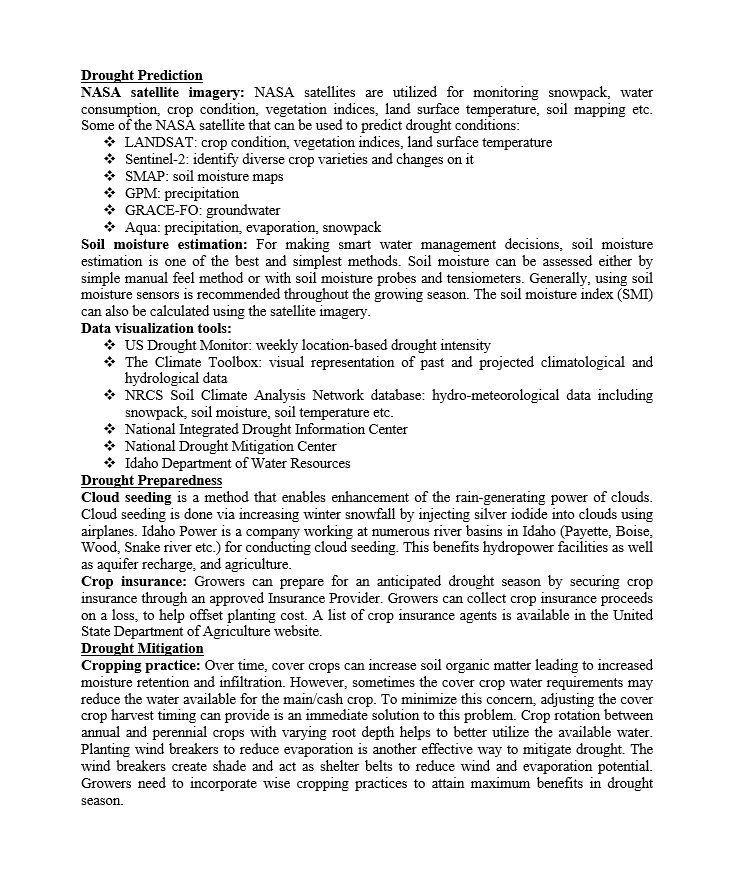
Drought is simply a prolonged period of water shortage. Drought can be caused by deficiency of water supply, increase in water demand, or both. Drought starts with less than usual precipitation and its persistence results in a decline in reservoir levels, river flow, and ground water levels. Agricultural drought occurs when the amount of soil moisture no longer meets the crop demand. The severity of drought depends on the degree of moisture deficiency, the duration, and the size of affected area. Drought can have tremendous negative effects on agricultural sector since it reduces both water availability and quality for farming. This significantly impacts the agricultural productivity.
2021 Idaho Hops Virtual Field Day
- UI Entomologist Justin Clements provides an overview of topics covered at this year’s virtual hops field day.
- Current and New Pesticide Technologies
- USDA Hops Genetics and Breeding
- Hops Entomology Research
- Hops Plant Pathology and Diagnostics
- Hops Agronomy
September 15, 2021
Varietal Response of Wheat and Barley to Nitrogen
The University of Idaho researchers and extension specialists are collaborating on a state-wide project to support the development and adoption of technologies that transform nutrients in dairy manure into commercial fertilizers and manure-based bioproducts. Updating nutrient management recommendations for Idaho crops (including wheat and barley) and evaluating the long-term effects of nitrogen fertilizers and newly developed manure-based bioproducts on soil carbon, nitrogen, and phosphorus levels plus soil health (e.g., microbial biomass, organic matter content, and soil carbon content) are among the key objectives.
Teff is a reliable low-risk crop. It is relatively resistant to biotic and abiotic stresses and can be grown under moisture stress or waterlogged conditions. Its short production cycle makes it useful as a rescue or catch crop in areas with limited water availability when perennials have failed. Growing teff as a double crop, green manure crop, cover crop or even an emergency crop when the unfavorable weather conditions delays planting of other grain crops is an excellent option. Teff is often grown as an economically viable rotational crop that’s compatible with a variety of commodity crops.