Thanks to Marketing & Comm. Manager, Ms. Amy Calabretta, University of Idaho Communications and Marketing
Brought to you by University of Idaho Extension:
We are excited to announce Ag Talk Tuesday sessions resume May 3 for the 2022 season.
Each session starts at 11:00 AM (MDT) on the first and third Tuesdays, May through August.
These live events begin with crop updates where all participants are invited to contribute, followed by a featured presentation. You can find a schedule of featured topics and speakers (subject to change) and more information on our website:
Registration is required to attend. You only need to register once to attend all sessions. Once you register, information on how to attend via Zoom or by calling in by phone will be sent to you in a separate email.
To register, click this link (or copy and paste the following into your web browser):
https://uidaho.zoom.us/meeting/register/tZElce6uqTwpH9CuQSsCTa_7B01HC8gfuGXn
Please join us starting May 3 at 11:00 AM (MDT) for these live, online sessions that focus on agriculture - current season issues related to pests, diseases, weeds, diagnostics, soil health, irrigation/water, agronomy & more along with featured topics and guest speakers.
For questions, please contact one of the organizers:
Kasia Duellman (kduellman@uidaho.edu)
Doug Finkelnburg (dougf@uidaho.edu)
Pam Hutchinson (phutch@uidaho.edu)
Juliet Marshall (jmarshall@uidaho.edu)
Olga Walsh (owalsh@uidaho.edu)
The Research Aide will provide assistance to the PI, Dr. Olga Walsh, as part of the Cropping Systems Agronomy research and extension program, and will conduct field, greenhouse, and laboratory experiments focused on plant nutrition, fertilizer, and water use efficiency. Location: University of Idaho, Parma R&E Center, Parma, Idaho.
First consideration date for receipt of applications is February 10, 2022.
Required Documents:
IMPORTANT: To be considered, your “Letter of Qualification” must address EACH of the required qualifications, including pertinent education and/or experience. In addition, to improve your ranking during the evaluation process, address as many of the Preferred Qualifications as possible. Information on a resume WILL NOT be accepted as a substitute for submitting a Letter of Qualification.
Posting Number: SP003222P
Location: Parma, Idaho
Division/College: Col of Agricultural & Life Sciences
Department: Plant Sciences
FLSA Status: Overtime Eligible
Employee Category: Classified
Pay Range: $15.46 per hour or higher depending on experience
Type of Appointment: Fiscal Year
Full Time/Part Time: Full Time
JOB DUTIES:
Conduct field/greenhouse/laboratory research and perform extension/outreach activities:
Hatzenbuehler, P., Wardropper, C., Adjesiwor, A., Ansah, E. O., Burnham, M., de Haro-Martí, Dentzman, K., Findlay, J. R., Glaze Jr., J. B., Hinds, J., Jansen, V., Karl, J., Lamichhane, R., Lew, R., Olsen, N., Powell, M., Running, K., Sagers, J., Schott, L., Walsh, O., and Wilson, B. 2021. Economic Impacts of Climate Change on Agriculture in Idaho. Idaho Climate-Economy Impacts Assessment. James A. & Louise McClure Center for Public Policy Research, University of Idaho. Boise, ID. pp 46
ICEIA main website: https://www.uidaho.edu/president/direct-reports/mcclure-center/iceia
ICEIA Agriculture website: https://www.uidaho.edu/president/direct-reports/mcclure-center/iceia/agriculture
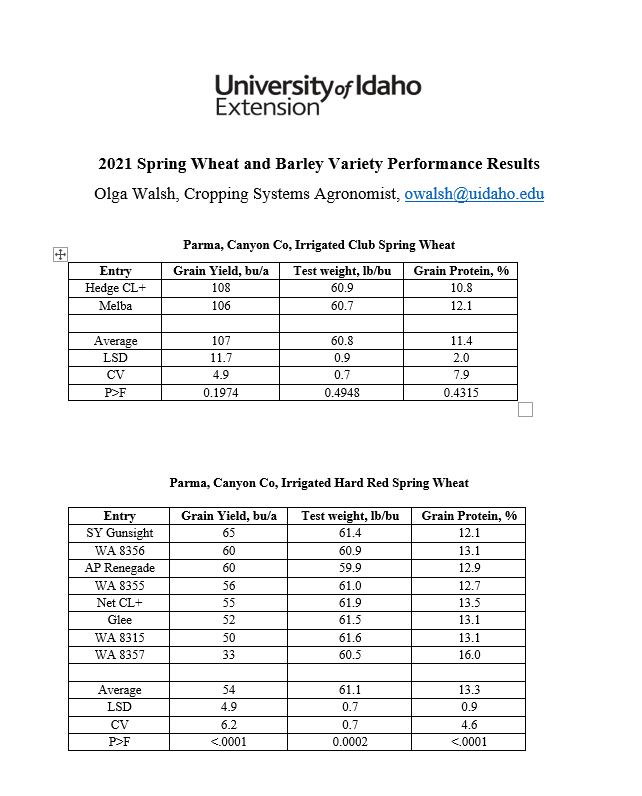
Both Hard Red Spring and Hard White Spring were trialed under irrigation. In a tough production year, the Hard Red trial averaged 54 bu/ac. with a mean test weight of 61.1 lbs. SY Gunsight, WA 8356, and AP Renegade were the top yielders. The Hard White trial yield was similar with a mean of 55 bu/ac. and an average test weight of 60.6 lbs. IDO2002S, SY Teton, and Dayn topped the entry list.
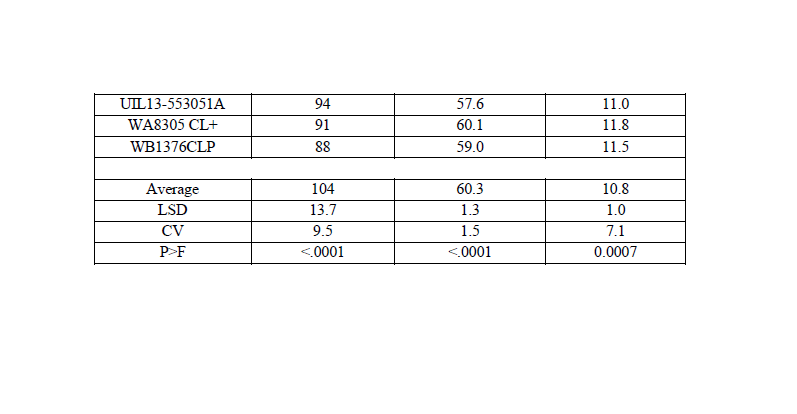
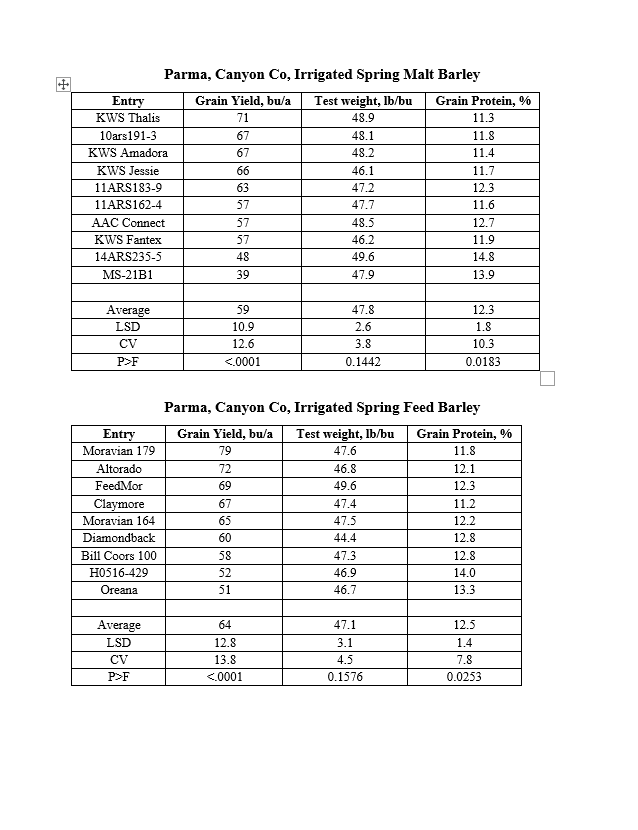
In the Soft White Spring trial, low yields pulled the mean trial yield to 47 bu/ac. while test weights held at an average of 60. IDO1902S, IDO1404S, and UI Stone produced the best in the challenging conditions. Preliminary results for irrigated club wheat, feed, and malt barley can be found at the same link. Further information about Dr. Walsh and her work can be found here.
By: Dr. Garrett R. Dudley, Research Manager, Idaho Wheat Commission
2. Walsh OS, Lamichhane R, Owusu Ansah, and E Nambi. 2021. Water Management for Optimized Hop Production in Idaho. Proc of the ASA International Annual meetings
3. Owusu Ansah E, Walsh OS, Liang X, Neibling H, and R Lamichhane. 2021. Irrigation Methods on Green Beans under Conventional vs Strip-Tillage. Proc of the ASA International Annual meetings
4. Owusu Ansah E, Walsh OS, Lamichhane R, and E Nambi. 2021. Stacking and Intersecting Nutrient 4R’s. Proc of the ASA International Annual meetings
5. Lamichhane R, Walsh OS, Spackman JA, Adjesiwor AT, Owusu Ansah E, and E Nambi. 2021. Varietal Response of Spring Barley to Applied Nitrogen. Proc of the ASA International Annual meetings
6. Lamichhane R, Walsh OS, Spackman JA, Adjesiwor AT, Owusu Ansah E., and E Nambi 2021. Varietal Response of Spring Wheat to Applied Nitrogen. Proc of the ASA International Annual meetings
7. Nambi E, and OS Walsh. 2021. Dryland Spring Wheat Performance in Response to Enhanced Efficiency Fertilizers in Montana. Proc of the ASA International Annual meetings
8. Nambi E., Lamichhane R, Owusu Ansah, and Olga S. Walsh. 2021. Effect of Preplant Nitrogen and Phosphorus Application Method and Source on Sorghum (Sorghum Bicolor L.) Grain Yields. Proc of the ASA International Annual meetings
9. Adjesiwor AT, J. Spackman, and Olga S. Walsh. 2021. Urea Ammonium Nitrate as the Carrier for Preplant Herbicides. Proc of the ASA International Annual meetings
2020 Idaho Sugar Beet Facts (National Agricultural Statistics Service-Idaho)
Ritika Lamichhane and Olga S. Walsh
Department of Plant Sciences, University of Idaho, Parma R&E Center
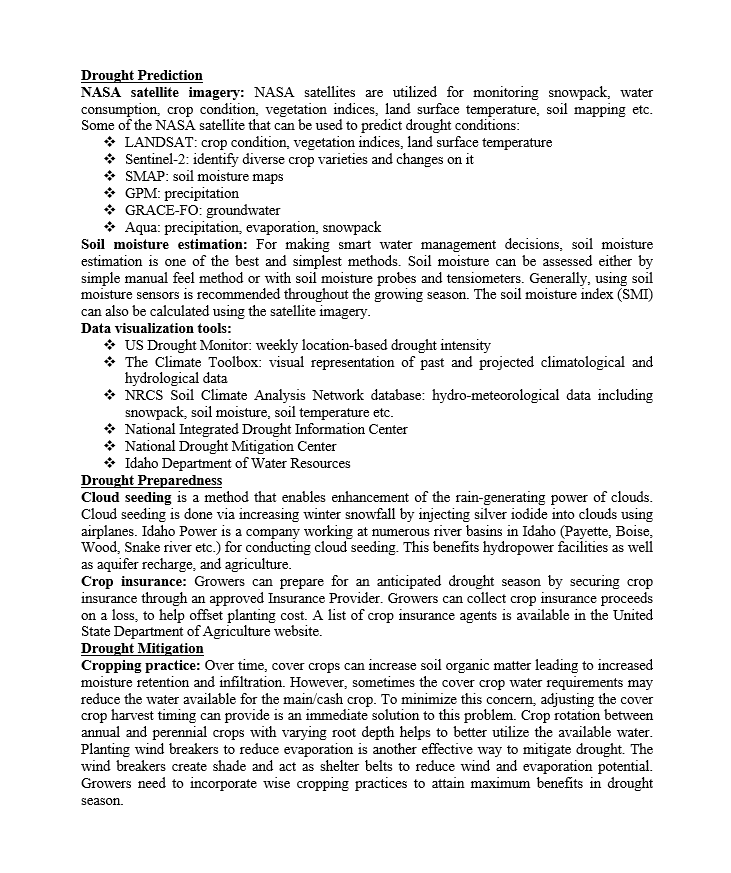
Drought is simply a prolonged period of water shortage. Drought can be caused by deficiency of water supply, increase in water demand, or both. Drought starts with less than usual precipitation and its persistence results in a decline in reservoir levels, river flow, and ground water levels. Agricultural drought occurs when the amount of soil moisture no longer meets the crop demand. The severity of drought depends on the degree of moisture deficiency, the duration, and the size of affected area. Drought can have tremendous negative effects on agricultural sector since it reduces both water availability and quality for farming. This significantly impacts the agricultural productivity.
The Western Society of Crop Science (WSCS) is a CSSA branch that comprises the states and provinces of Alaska, Alberta, Arizona, American Samoa, Baja California, Baja California Sur, British Columbia, California, Chihuahua, Colima, Colorado, Durango, Guam, Hawaii, Idaho, Jalisco, Montana, Nayarit, Nevada, New Mexico, Northwest Territories, Oregon, Saskatchewan, Sinaloa, Sonora, Utah, Washington, Wyoming, and Yukon Territory.
The 2021 WSCS virtual conference took place June 22-23 utilizing Zoom. The theme of the WSCS meeting was the same as that of the 2021 ASA, CSSA, SSSA Annual Meeting “A Creative Economy for Sustainable Development. The meeting was attended by 20 participants from New Mexico State University, Montana State University, University of Wyoming, Washington State University, Brigham Young University, University of Idaho, and Columbia Basin College.
Analyzing data from drones is very time-consuming and requires specific, high-level knowledge of software, even statistics.
“Data analysis is followed by data interpretation—which is, perhaps, the most vital part in the whole process,” says Olga Walsh, research associate professor at the College of Agricultural and Life Sciences at the University of Idaho.