Pages
- HOME
- ABOUT
- SCHOLARLY PUBLICATIONS
- RESEARCH
- TEACHING & MENTORING
- EXTENSION & OUTREACH
- SERVICE
- UI Parma Agronomy Program
- Idaho Crops & Soils Newsletter
- Southwest Idaho Cereals Program
- Nutrient 4Rs
- Soil Health
- University of Idaho AgTalk Tuesdays
- Western Ag Variety Explorer - WAVE
- UAV for Fruit Tree Monitoring
- Micronutrients for Wheat
- Precision Irrigation for Hops
- Water and Soil Management for Beans
- Nitrogen and Water Management for Sugar Beets
- Water and Nutrient Footprint of Pulse Crops
- PLSC 500 - Master's Research & Thesis
June 20, 2019
May 17, 2019
Understanding Factors Controlling Ammonia Volatilization from Fertilizer Nitrogen Applications.
Biswanath Dari, Christopher W. Rogers, and Olga S. Walsh
Best Management Practices to Minimize Ammonia Volatilization Losses from Fertilizer Nitrogen Applications.
Christopher W. Rogers, Biswanath Dari, and Olga S. Walsh
Sugar Beets Research Update
Nitrogen and
Water Management for Optimized Sugar Beet Yield and Sugar Content
Principal Researchers: Olga
Walsh and Sanaz Shafian
Affiliation: Olga
Walsh, University of Idaho
Address:
29603 U of I Lane, Parma ID 83660; (208) 291-6218
Principal Contact Email:
owalsh@uidaho.edu
We are grateful to the Snake River Sugarbeet Research and Seed Alliance LLC and the Amalgamated Sugar Company for funding and supporting this project.
Sugar beet (SB) production profitability
is based on maximizing three parameters: beet yield, sucrose content, and
sucrose recovery efficiency. Efficient nitrogen (N) and water management are
key for successful SB production. Nitrogen deficits in the soil can reduce root
and sugar yield. Overapplication of N can reduce sucrose content and increase
nitrate impurities which lowers sucrose recovery. Application of N in excess of
SB crop need leads to vigorous canopy growth, while compromising root
development and sugar production. Changes in SB varieties and management
practices warrant re-evaluation of N management. TASCO and the USDA-ARS found
that in 60% of evaluated SB fields, application of N did not increase sucrose
yield. This suggests that residual soil N from past applications and in-season
N mineralization was adequate and indicates that growers could maximize sugar
yield and save money by applying less N. Due to recommendation to have all N
applied and plant-available by 4-6 leaves, it is imperative to determine the appropriate
N application rates for N responsive fields early in the season. Appropriate
irrigation amount and timing can optimize SB yields while minimizing disease
pressure, water costs and N leaching. Excessive irrigation can increase SB root
weight, but lower sugar content. Defining the optimum water and N fertilizer
levels should be done on a regional basis, utilizing locally grown varieties and
taking into account local management practices. Remote sensing is a promising
tool for in-season N and water management and in-season prediction of SB yield
and quality, which in turn can improve the economic returns to SB growers and
processors. Crop sensors can accurately measure SB biomass production and top N
content. Spectral indices are correlated
with N rates applied to SB can be used for in-season prediction of SB yield and
quality and to make N management decisions.
List of
Objectives
The goal is to improve water and N use
efficiency for agronomically, economically, and environmentally sustainable SB
production by combining traditional and novel, state-of-the-art methodologies.
1. To analyze the effects of water and N
fertilizer rates on SB yield and quality,
2. To explore the potential of using
ground- and aerial-based (UAVs) data for SB N and water content monitoring,
3. To access the feasibility of
predicting SB root yield and recoverable sugar using hand-held and UAV-based
sensors, and
4. To conduct extension outreach focused
on water and nutrient management in SB, remote sensing, and UAV use for crop
monitoring.
Sugar beet planting, April 18, 2019
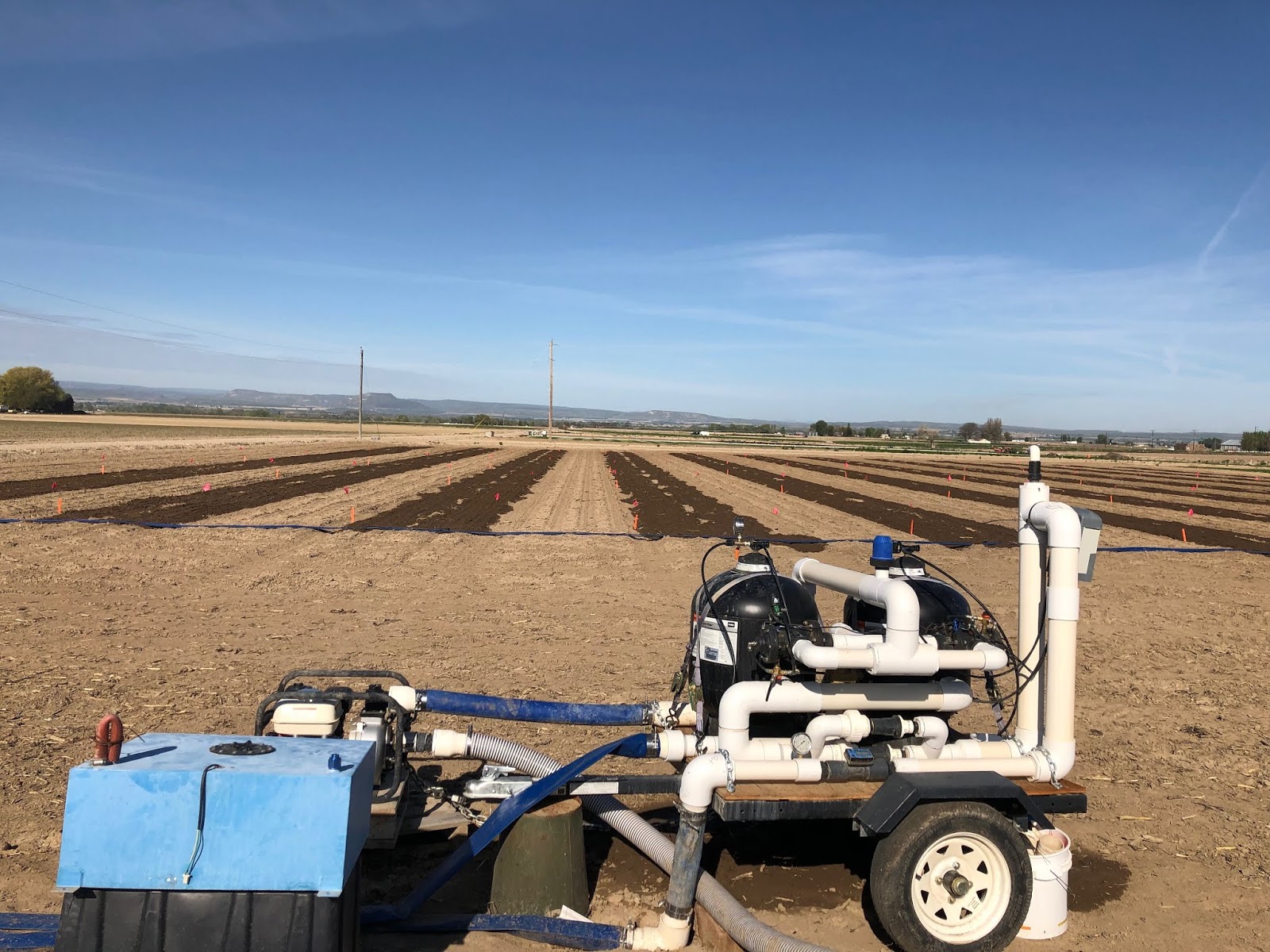
Irrigating the research plots using the subsurface drip irrigation system, April 25, 2019
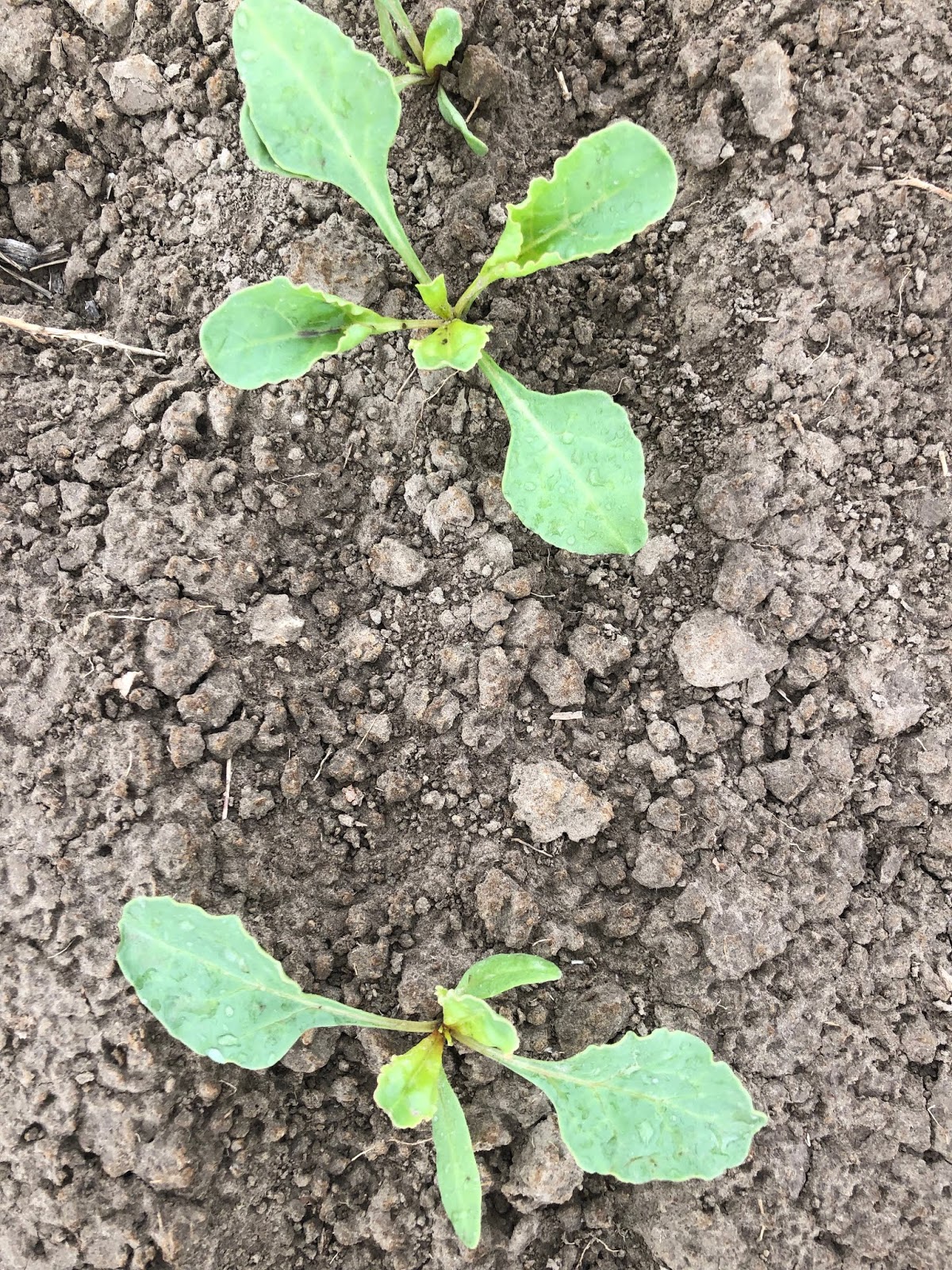
Sugar beets emergence, April 26, 2019
Water treatment differences, May 16, 2019:
100% water applied; 12 h set
50 % water applied; 6 h set
May 08, 2019
March 14, 2019
March 06, 2019
Western Society of Crop Science 2019 Annual Meeting - June 25-26, 2019 Tri-Cities, WA
| |
| |
|
August 29, 2018
August 20, 2018
9th Biennial Idaho Nutrient Management Conference, November 15, 2018, Twin Falls, Idaho
We are pleased to announce that the 9th Biennial Idaho Nutrient Management Conference will take place November 15, 2018 in Twin Falls area (more details on the venue will be available shortly).
The purpose of this one day conference is to demonstrate the various research projects that are being conducted by the University of Idaho and USDA-ARS, and to identify needs for research in order to fill gaps that may arise.
Continued nutrient management education is vital to the state of Idaho.
This conference has been, and will remain, a valuable means of providing up-to-date research information to ensure that nutrient management planning will be agronomically and environmentally sound.
Typical attendance have been between 50 and 100.
On the behalf of this years’ planning committee, I invite you to:
- Participate by presenting an oral or a poster presentation. The broad focus areas are: 1) crops & soils; 2) manure; 3) irrigation & nutrients
- Suggest keynote speakers to open the conference with a 30 min presentation
- Volunteer to peer-review 1-2 proceedings papers as service to your colleagues
- Please forward to anyone who might be interested
Thank you!
UI Nutrient Management Conference Planning Committee:
Olga Walsh, Cropping Systems Agronomist, Parma, ID, Chair
Lide Chen, Waste Management Engineer, Twin Falls, ID, Co-Chair
Richard Norell, Dairy Specialist, Idaho Falls, ID
Jim Ekins, Area Water Educator, Coeur d’Alene, ID
Lauren Golden, Blaine County Extension Educator, Hailey, ID
Mario de Haro Marti, Gooding County Extension Educator, Gooding, ID
Olga
S. Walsh, Ph.D.
2018 Chair of NMC Planning
Committee
Cropping Systems Agronomist
& Extension Specialist, Assistant Professor
University of Idaho, College
of Agricultural and Life Sciences, Department of Plant Sciences, Parma
Research & Extension Center 29603 U of I Lane, Parma, ID 83660, Phone:
(208)291-6218
Twitter: @IDCrops
|
Lide Chen, Ph.D.
2018 Co-Chair of NMC Planning Committee
Waste Management Engineer,
Associate Professor
University of Idaho, College of Agricultural and Life Sciences, Department
of Soil and Water Systems, Twin Falls Research & Extension Center, CSI
Evergreen Building, 315 Falls Avenue, P. O. Box 1827, Twin Falls, ID
83303-1827, Phone: (208)736-3615
|
April 17, 2018
January 29, 2018
Agricultural Technician position OPEN, University of Idaho, Parma R&E Center
For more information and to apply please go HERE!
January 15, 2018
December 15, 2017
November 15, 2017
Subscribe to:
Posts (Atom)