Pages
- HOME
- ABOUT
- SCHOLARLY PUBLICATIONS
- RESEARCH
- TEACHING & MENTORING
- EXTENSION & OUTREACH
- SERVICE
- UI Parma Agronomy Program
- Idaho Crops & Soils Newsletter
- Southwest Idaho Cereals Program
- Nutrient 4Rs
- Soil Health
- University of Idaho AgTalk Tuesdays
- Western Ag Variety Explorer - WAVE
- UAV for Fruit Tree Monitoring
- Micronutrients for Wheat
- Precision Irrigation for Hops
- Water and Soil Management for Beans
- Nitrogen and Water Management for Sugar Beets
- Water and Nutrient Footprint of Pulse Crops
- PLSC 500 - Master's Research & Thesis
May 13, 2015
Parma Cereal Field Day - June 25!
2015 OSU/UI Cereals Day
Parma Research & Extension Center
29603 U of I Lane Parma, ID 83660
June 25, 2015 12 noon to 4:30
A review of wheat and barley lines and cereal-related research.
AGENDA:
12:00 Noon: Registration
12:30 -1:00: Welcome and
Lunch
Research and extension program:
1:15-1:30: Trial
Implementation - Olga Walsh
1:30 - 1:45: Nitrogen and
Water Use in Wheat - Olga Walsh/Arjun Pandey, U of I
1:45-2:00: Wheat –Based
Cropping Systems - Xi Liang, U of I
2:15-2:45: Cereal pathology
- Juliet Marshall, U of I
Breeding program:
2:55-3:25: Mike Flowers,
OSU
3:30-4:00: Bob Zemetra, OSU
4:00-4:30-Discussion/Walking the plots
Thank you to Idaho Barley Commission and Idaho Wheat Commission for supporting cereal research and
education and for sponsoring lunch!
The Oregon State University Extension Service engages the people of Oregon with research-based knowledge and education that strengthen communities and economies, sustain natural resources, and promote healthy families and individuals. The Extension Service offers its programs and materials equally to all people.
University
of Idaho Extension improves people's lives by engaging the University and our
communities through research-based education. Our areas of expertise are
Agriculture, Community Development, Family and Consumer Sciences, Natural
Resources, and Youth Development.
To
enrich education through diversity the University of Idaho is an equal
opportunity/affirmative action employer and educational institution.
***OSU
Oregon Elite Yield Trial Results:
***U
of I, Treasure Valley Small Grain Variety Performance:
May 07, 2015
More Barley Yellow Dwarf Pictures, Caldwell ID
These pictures of headed winter wheat were taken this morning near Caldwell, ID. Note smaller, less developed, paler, stunted plants. Also note bright yellow/orange wheat leaf tips. These are the typical Barely Yellow Dwarf symptoms.
Again, for more information on BYD, please go to the University of Idaho publication - "Barley Yellow Dwarf Virus in Idaho Cereal Crops", that describes the symptoms as:
"Yellowing and/or reddening of leaves starting at the leaf tip and moving toward the base and inward from the margins"
"The affected plants exhibit stunting of both foliar and root tissues".
![]() |
| Photos by Olga Walsh, University of Idaho Cropping Systems Agronomist, Parma Research & Extension Center. Taken 05/07/2015 |
Again, for more information on BYD, please go to the University of Idaho publication - "Barley Yellow Dwarf Virus in Idaho Cereal Crops", that describes the symptoms as:
"Yellowing and/or reddening of leaves starting at the leaf tip and moving toward the base and inward from the margins"
"The affected plants exhibit stunting of both foliar and root tissues".
Our Blog Visitors
Since February 2015, Idaho Crops & Soils News Blog has been visited by clientele from 13 countries worldwide, including (in alphabetical order):
Australia, Bangladesh, Brazil, Canada, China, Egypt, France, Germany, India, Ireland, Mexico, Pakistan, South Africa, Sweden, Thailand, United Kingdom, and United States.
A total number of 1,055 pages has been viewed since February.
The United States had the top number of visitors from the following 18 states:
Idaho, California, Washington, Montana, Oregon, Texas, Alabama, Utah, Arizona, North Dakota, South Dakota, Wisconsin, Georgia, Virginia, District of Columbia, Delaware, and New York.
|
|
May 06, 2015
Stripe Rust and Snow Mold Update
Update from Juliet Marshall, University of Idaho Cereal Cropping Systems Specialist and Pathologist.
1) Dr.David Hole, USU, has found stripe rust in a breeding nursery in Logan, UT.
Heading has started. Varieties affected included Lewjain, Lucin CL, and an
advanced breeding line. Scouting is recommended throughout southern and eastern
Idaho.
2)
Yesterday
afternoon I was at the Tetonia Research Station rating winter wheat for snowmold, and I noticed stripe rust on some lines that were from Washington State’s
pathology program. I don’t know the line names / pedigree of infected lines. The
stripe rust was on both lower leaves and mid-canopy on plants that were late
tillering to jointing.
It is possible that the infection overwintered, however
I was there April 21, and saw no evidence of stripe rust. The snow mold
infections were pretty good, with many of the overwintering leaves destroyed. I
think this is an early spring infection (this season). The nursery is being
destroyed today, so that should remove the source. However, if I had
susceptible lines of spring or winter wheat, I would be spraying fungicides at
herbicide application. The
current temperatures are conducive to infection, and these localized
thunderstorms will assist in spread and the moisture conditions that promote
infection.
Please
see the appendices in the 2014 Small Grains Report for last year’s ratings of
the spring wheat lines: http://www.uidaho.edu/extension/cereals/scseidaho/sgr
Please
let me know if you see stripe rust in your area!
*************************************************************************
Update from Olga Walsh, University of Idaho Cropping Systems Agronomist, Parma Research & Extension Center.
Stripe rust was identified in winter wheat extension nurseries at University of Idaho, Parma Research & Extension Center - one leaf on one plant only has been affected so far. Scouting will be continued. Fungicides will be applied to contain the disease spread to other areas.
May 05, 2015
April 29, 2015
Cereal Leaf Beetle in Winter Wheat, Canyon County
Cereal
leaf beetle (Oulema melanopus) infestation was identified in winter
wheat experimental plots at the University of Idaho Parma Research and
Extension Center as well as in surrounding grower fields in Canyon County. The typical
feeding patterns, eggs and larvae have been confirmed by Dr. James Barbour, UI
IPM Specialist. The first symptoms of infestation became apparent last week. Currently,
most plants have at least one leaf with obvious feeding damage. The cereal leaf
beetle has a variety of hosts among cereals and grasses with preference to oat,
barley, wheat, rye, timothy, fescue, grain sorghum and corn. Substantial crop
yield loss and quality decrease can be expected due to lost photosynthetic
activity resulting from the feeding damage.
Cereal leaf
beetle is a quarantined insect the U.S., which means that the presence of beetles
in grain restricts exports to uninfested areas. Fumigation is required to
prevent the spread of beetle infestation.
Scouting of fields is vital both before and during the
boot stage to assess for cereal leaf beetle presence and damage. It is
recommended to scout
weekly by walking through the field in a “W” pattern for best coverage. Stop at
5-10 locations depending on field size and examine 10 plants per location. Count
the number of eggs and larvae per
plant for smaller plants or per stem for larger plants.
Winter wheat leaves affected by cereal leaf beetle, University of Idaho Parma R&E Center, Parma, ID, April 2015.
Treatment
thresholds: 3 larvae per plant and/or 3 eggs per plant before
boot stage, and 1 larva per flag leaf after boot stage.
Management-chemical control (From
PNW Insect Management Handbook)
- bifenthrin (BrigadeÆ 2EC and WSB) at 6.4 fl oz/a (0.1 lb ai/a). Apply in spring if one or more eggs or larvae are detected or in late summer if beetles are defoliating seedling stands. Maximum amount allowed 12.8 fl oz/a (0.2 lb ai/a) per season but no more than once every 12 days. PHI 30 days prior to harvest for forage, hay and seed.
- cyfluthrin (Baythroid XL) at 0.013 to 0.015 lb ai/a. PHI 0 days. REI 12 hr. Maximum amount allowed per 5 day interval is 0.022 lb ai/a. Maximum amount allowed per crop season is 0.089 lb ai/a.
- lambda-cyhalothrin (Warrior) at 0.02 to 0.03 lb ai/a. PHI 0 days for grazing and forage, 7 days for straw and seed crop. REI 24 hr.
- zeta-cypermethrin (Mustang MAX) at 0.0175 to 0.025 lb ai/a. PHI 0 days forage, hay; 7 days straw and seed screenings. REI 12 hr. For forage and hay use no more than 0.10 lb ai/a per season; make subsequent applications no closer than 7 days. For straw and seed screenings use no more than 0.125 lb ai/a per season; make subsequent applications no closer than 17 days.
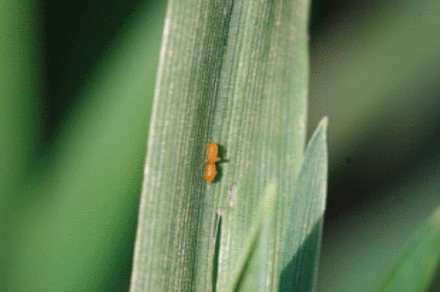
![]() | ||||||
| Cereal Leaf Beetle eggs. Phillips et al., 2011 (http://jipm.oxfordjournals.org/content/jipm/2/2/C1.full.pdf) |
![]() |
Windowpaning. One side of the leaf is scrapped off leaving
the other side intact and translucent.
This gives the feeding lesion a window-like appearance. Primarily caused by some young beetle and
moth larvae. (University of Kentucky,
http://www.uky.edu/Classes/ENT/530/Exam1slides.ppt. )
University of Idaho CIS on cereal leaf beetle: http://www.cals.uidaho.edu/edcomm/pdf/CIS/CIS0994.pdf
|
Subscribe to:
Posts (Atom)